 Add to Chrome
 Add to Firefox
 Add to Edge
SkillGenBench: Benchmarking Skill Generation Pipelines for LLM Agents
May 18, 2026
As LLM agents are increasingly built around reusable skills, a central challenge is no longer only whether agents can use provided skills, but whether they can generate correct, reusable, and executable skills from repositories and documents. Existing benchmarks primarily evaluate the efficacy of given skills or the ability of agents to solve downstream tasks from raw context, but they do not isolate skill generation itself as the object of study. We introduce SkillGenBench, a benchmark for evaluating skill generation pipelines under a unified and controlled protocol. In SkillGenBench, a generator receives raw corpora and produces standardized skill artifacts, which are then executed under fixed harnesses and assessed with unified evaluation procedures. The benchmark covers two generation regimes: task-conditioned generation, where a task-specific skill is synthesized after the task is revealed, and task-agnostic generation, where a reusable skill library must be distilled before downstream tasks are known. It also spans two complementary procedural sources: repository-grounded instances, where procedures are distributed across code, configuration, and scripts, and document-grounded instances, where procedures and constraints must be distilled from long-form text. We provide standardized task specifications, pinned environments, and evaluation protocols centered on deterministic execution-based checks, supplemented by auxiliary signals for diagnosis. Experiments across a range of skill-generation methods and backbones show substantial performance variation, highlight the difficulty of reusable skill distillation, and reveal distinct failure modes in skill generation from software repositories versus long-form documents. SkillGenBench establishes a reproducible testbed for studying skill generation as an independent research problem in agent systems.

Atomic Trajectory Modeling with State Space Models for Biomolecular Dynamics
Mar 18, 2026Understanding the dynamic behavior of biomolecules is fundamental to elucidating biological function and facilitating drug discovery. While Molecular Dynamics (MD) simulations provide a rigorous physical basis for studying these dynamics, they remain computationally expensive for long timescales. Conversely, recent deep generative models accelerate conformation generation but are typically either failing to model temporal relationship or built only for monomeric proteins. To bridge this gap, we introduce ATMOS, a novel generative framework based on State Space Models (SSM) designed to generate atom-level MD trajectories for biomolecular systems. ATMOS integrates a Pairformer-based state transition mechanism to capture long-range temporal dependencies, with a diffusion-based module to decode trajectory frames in an autoregressive manner. ATMOS is trained across crystal structures from PDB and conformation trajectory from large-scale MD simulation datasets including mdCATH and MISATO. We demonstrate that ATMOS achieves state-of-the-art performance in generating conformation trajectories for both protein monomers and complex protein-ligand systems. By enabling efficient inference of atomic trajectory of motions, this work establishes a promising foundation for modeling biomolecular dynamics.
Chain of Mindset: Reasoning with Adaptive Cognitive Modes
Feb 10, 2026Human problem-solving is never the repetition of a single mindset, by which we mean a distinct mode of cognitive processing. When tackling a specific task, we do not rely on a single mindset; instead, we integrate multiple mindsets within the single solution process. However, existing LLM reasoning methods fall into a common trap: they apply the same fixed mindset across all steps, overlooking that different stages of solving the same problem require fundamentally different mindsets. This single-minded assumption prevents models from reaching the next level of intelligence. To address this limitation, we propose Chain of Mindset (CoM), a training-free agentic framework that enables step-level adaptive mindset orchestration. CoM decomposes reasoning into four functionally heterogeneous mindsets: Spatial, Convergent, Divergent, and Algorithmic. A Meta-Agent dynamically selects the optimal mindset based on the evolving reasoning state, while a bidirectional Context Gate filters cross-module information flow to maintain effectiveness and efficiency. Experiments across six challenging benchmarks spanning mathematics, code generation, scientific QA, and spatial reasoning demonstrate that CoM achieves state-of-the-art performance, outperforming the strongest baseline by 4.96\% and 4.72\% in overall accuracy on Qwen3-VL-32B-Instruct and Gemini-2.0-Flash, while balancing reasoning efficiency. Our code is publicly available at \href{https://github.com/QuantaAlpha/chain-of-mindset}{https://github.com/QuantaAlpha/chain-of-mindset}.
QuantaAlpha: An Evolutionary Framework for LLM-Driven Alpha Mining
Feb 06, 2026Financial markets are noisy and non-stationary, making alpha mining highly sensitive to noise in backtesting results and sudden market regime shifts. While recent agentic frameworks improve alpha mining automation, they often lack controllable multi-round search and reliable reuse of validated experience. To address these challenges, we propose QuantaAlpha, an evolutionary alpha mining framework that treats each end-to-end mining run as a trajectory and improves factors through trajectory-level mutation and crossover operations. QuantaAlpha localizes suboptimal steps in each trajectory for targeted revision and recombines complementary high-reward segments to reuse effective patterns, enabling structured exploration and refinement across mining iterations. During factor generation, QuantaAlpha enforces semantic consistency across the hypothesis, factor expression, and executable code, while constraining the complexity and redundancy of the generated factor to mitigate crowding. Extensive experiments on the China Securities Index 300 (CSI 300) demonstrate consistent gains over strong baseline models and prior agentic systems. When utilizing GPT-5.2, QuantaAlpha achieves an Information Coefficient (IC) of 0.1501, with an Annualized Rate of Return (ARR) of 27.75% and a Maximum Drawdown (MDD) of 7.98%. Moreover, factors mined on CSI 300 transfer effectively to the China Securities Index 500 (CSI 500) and the Standard & Poor's 500 Index (S&P 500), delivering 160% and 137% cumulative excess return over four years, respectively, which indicates strong robustness of QuantaAlpha under market distribution shifts.
Spider-Sense: Intrinsic Risk Sensing for Efficient Agent Defense with Hierarchical Adaptive Screening
Feb 05, 2026As large language models (LLMs) evolve into autonomous agents, their real-world applicability has expanded significantly, accompanied by new security challenges. Most existing agent defense mechanisms adopt a mandatory checking paradigm, in which security validation is forcibly triggered at predefined stages of the agent lifecycle. In this work, we argue that effective agent security should be intrinsic and selective rather than architecturally decoupled and mandatory. We propose Spider-Sense framework, an event-driven defense framework based on Intrinsic Risk Sensing (IRS), which allows agents to maintain latent vigilance and trigger defenses only upon risk perception. Once triggered, the Spider-Sense invokes a hierarchical defence mechanism that trades off efficiency and precision: it resolves known patterns via lightweight similarity matching while escalating ambiguous cases to deep internal reasoning, thereby eliminating reliance on external models. To facilitate rigorous evaluation, we introduce S$^2$Bench, a lifecycle-aware benchmark featuring realistic tool execution and multi-stage attacks. Extensive experiments demonstrate that Spider-Sense achieves competitive or superior defense performance, attaining the lowest Attack Success Rate (ASR) and False Positive Rate (FPR), with only a marginal latency overhead of 8.3\%.
BinaryDemoire: Moiré-Aware Binarization for Image Demoiréing
Feb 03, 2026Image demoiréing aims to remove structured moiré artifacts in recaptured imagery, where degradations are highly frequency-dependent and vary across scales and directions. While recent deep networks achieve high-quality restoration, their full-precision designs remain costly for deployment. Binarization offers an extreme compression regime by quantizing both activations and weights to 1-bit. Yet, it has been rarely studied for demoiréing and performs poorly when naively applied. In this work, we propose BinaryDemoire, a binarized demoiréing framework that explicitly accommodates the frequency structure of moiré degradations. First, we introduce a moiré-aware binary gate (MABG) that extracts lightweight frequency descriptors together with activation statistics. It predicts channel-wise gating coefficients to condition the aggregation of binary convolution responses. Second, we design a shuffle-grouped residual adapter (SGRA) that performs structured sparse shortcut alignment. It further integrates interleaved mixing to promote information exchange across different channel partitions. Extensive experiments on four benchmarks demonstrate that the proposed BinaryDemoire surpasses current binarization methods. Code: https://github.com/zhengchen1999/BinaryDemoire.
EvoFSM: Controllable Self-Evolution for Deep Research with Finite State Machines
Jan 14, 2026While LLM-based agents have shown promise for deep research, most existing approaches rely on fixed workflows that struggle to adapt to real-world, open-ended queries. Recent work therefore explores self-evolution by allowing agents to rewrite their own code or prompts to improve problem-solving ability, but unconstrained optimization often triggers instability, hallucinations, and instruction drift. We propose EvoFSM, a structured self-evolving framework that achieves both adaptability and control by evolving an explicit Finite State Machine (FSM) instead of relying on free-form rewriting. EvoFSM decouples the optimization space into macroscopic Flow (state-transition logic) and microscopic Skill (state-specific behaviors), enabling targeted improvements under clear behavioral boundaries. Guided by a critic mechanism, EvoFSM refines the FSM through a small set of constrained operations, and further incorporates a self-evolving memory that distills successful trajectories as reusable priors and failure patterns as constraints for future queries. Extensive evaluations on five multi-hop QA benchmarks demonstrate the effectiveness of EvoFSM. In particular, EvoFSM reaches 58.0% accuracy on the DeepSearch benchmark. Additional results on interactive decision-making tasks further validate its generalization.
RLPO: Residual Listwise Preference Optimization for Long-Context Review Ranking
Jan 12, 2026Review ranking is pivotal in e-commerce for prioritizing diagnostic and authentic feedback from the deluge of user-generated content. While large language models have improved semantic assessment, existing ranking paradigms face a persistent trade-off in long-context settings. Pointwise scoring is efficient but often fails to account for list-level interactions, leading to miscalibrated top-$k$ rankings. Listwise approaches can leverage global context, yet they are computationally expensive and become unstable as candidate lists grow. To address this, we propose Residual Listwise Preference Optimization (RLPO), which formulates ranking as listwise representation-level residual correction over a strong pointwise LLM scorer. RLPO first produces calibrated pointwise scores and item representations, then applies a lightweight encoder over the representations to predict listwise score residuals, avoiding full token-level listwise processing. We also introduce a large-scale benchmark for long-context review ranking with human verification. Experiments show RLPO improves NDCG@k over strong pointwise and listwise baselines and remains robust as list length increases.
BizFinBench.v2: A Unified Dual-Mode Bilingual Benchmark for Expert-Level Financial Capability Alignment
Jan 10, 2026Large language models have undergone rapid evolution, emerging as a pivotal technology for intelligence in financial operations. However, existing benchmarks are often constrained by pitfalls such as reliance on simulated or general-purpose samples and a focus on singular, offline static scenarios. Consequently, they fail to align with the requirements for authenticity and real-time responsiveness in financial services, leading to a significant discrepancy between benchmark performance and actual operational efficacy. To address this, we introduce BizFinBench.v2, the first large-scale evaluation benchmark grounded in authentic business data from both Chinese and U.S. equity markets, integrating online assessment. We performed clustering analysis on authentic user queries from financial platforms, resulting in eight fundamental tasks and two online tasks across four core business scenarios, totaling 29,578 expert-level Q&A pairs. Experimental results demonstrate that ChatGPT-5 achieves a prominent 61.5% accuracy in main tasks, though a substantial gap relative to financial experts persists; in online tasks, DeepSeek-R1 outperforms all other commercial LLMs. Error analysis further identifies the specific capability deficiencies of existing models within practical financial business contexts. BizFinBench.v2 transcends the limitations of current benchmarks, achieving a business-level deconstruction of LLM financial capabilities and providing a precise basis for evaluating efficacy in the widespread deployment of LLMs within the financial domain. The data and code are available at https://github.com/HiThink-Research/BizFinBench.v2.
RLinf: Flexible and Efficient Large-scale Reinforcement Learning via Macro-to-Micro Flow Transformation
Sep 19, 2025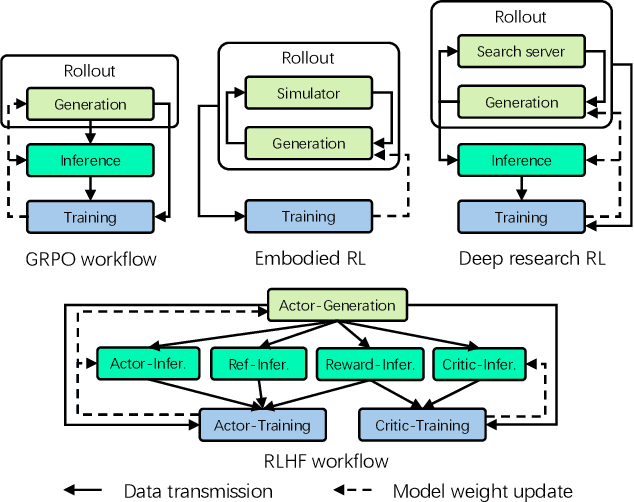
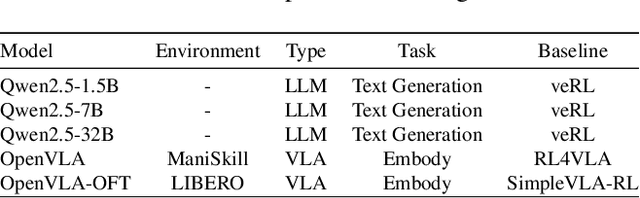
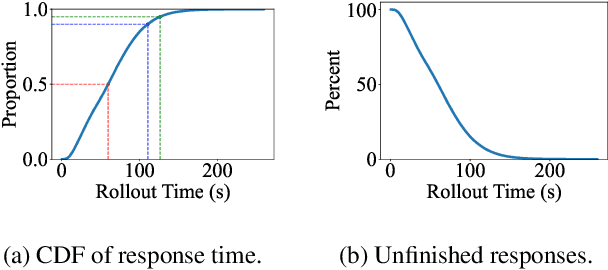
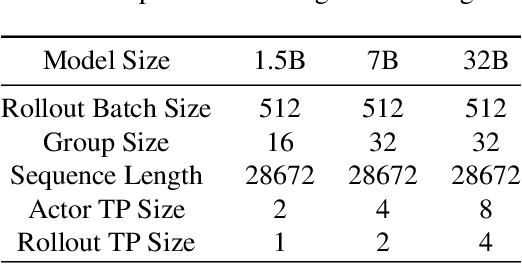
Reinforcement learning (RL) has demonstrated immense potential in advancing artificial general intelligence, agentic intelligence, and embodied intelligence. However, the inherent heterogeneity and dynamicity of RL workflows often lead to low hardware utilization and slow training on existing systems. In this paper, we present RLinf, a high-performance RL training system based on our key observation that the major roadblock to efficient RL training lies in system flexibility. To maximize flexibility and efficiency, RLinf is built atop a novel RL system design paradigm called macro-to-micro flow transformation (M2Flow), which automatically breaks down high-level, easy-to-compose RL workflows at both the temporal and spatial dimensions, and recomposes them into optimized execution flows. Supported by RLinf worker's adaptive communication capability, we devise context switching and elastic pipelining to realize M2Flow transformation, and a profiling-guided scheduling policy to generate optimal execution plans. Extensive evaluations on both reasoning RL and embodied RL tasks demonstrate that RLinf consistently outperforms state-of-the-art systems, achieving 1.1x-2.13x speedup in end-to-end training throughput.